Published by:
CGP EDU Academic Team
Published on: September 12, 2026
A photon of energy 5.4852 eV liberates an electron from the Li-atom initially at rest. The emitted electron moves at right angles to the direction in which the photon moves. Find the speed and the direction in which the Li 2+ ion will move. Ionization potential of Li-atom 5.3918 V, atomic weight = 6.94 g, N = 6.02 × 10 23 /mol and m e = 9.1 × 10 –31 kg.
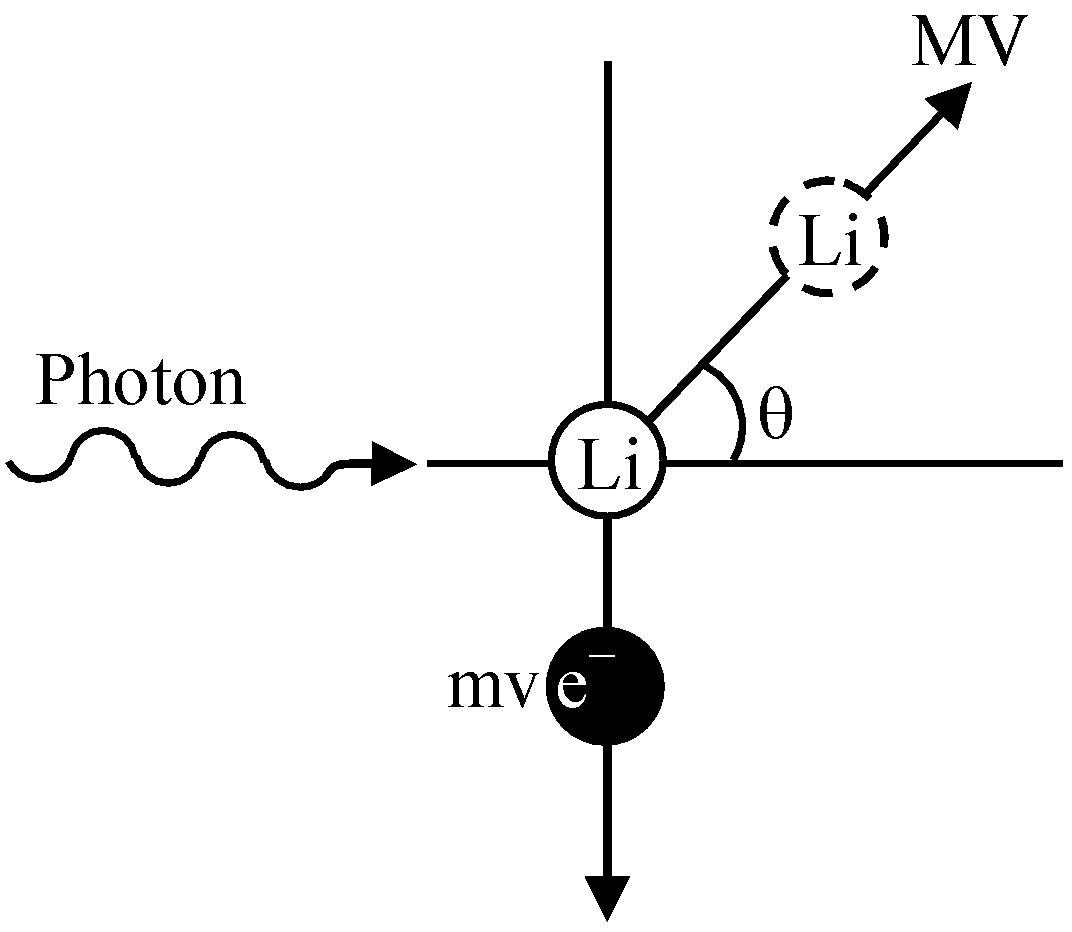
Text Solution
Verified by ExpertsThe correct answer is:
B
Step 1: Calculate the energy available for the electron's kinetic energy after photoemission.
The energy of the photon is given as E_{photon} = 5.4852 ext{ eV}.
The ionization potential of the Li atom is E_{ionization} = 5.3918 ext{ eV}.
The excess energy (which becomes kinetic energy) is calculated as follows:
K.E. = E_{photon} - E_{ionization} = 5.4852 ext{ eV} - 5.3918 ext{ eV} = 0.0934 ext{ eV}.
Step 2: Convert the kinetic energy to joules.
1 ext{ eV} = 1.6 imes 10^{-19} ext{ J}, thus: K.E. = 0.0934 ext{ eV} * 1.6 imes 10^{-19} ext{ J/eV} = 1.4944 imes 10^{-20} ext{ J}.
Step 3: Use the kinetic energy equation to find the speed of the emitted electron.
K.E. = \frac{1}{2} m_{e} v^{2}
Rearranging gives: v = \sqrt{\frac{2 K.E.}{m_{e}}} = \sqrt{\frac{2 (1.4944 \times 10^{-20})}{9.1 \times 10^{-31}}}
Calculating this gives v \approx 1.73 \times 10^{5} ext{ m/s}.
Step 4: Analyze momentum conservation for the movement of the Li ion.
Since momentum is conserved, we have: \( m_{e} v_{e} = m_{Li^{2+}} v_{Li^{2+}} \), where \( m_{Li^{2+}} \) = \( \frac{6.94}{3} \times 10^{-3} \text{ kg} \) (for Li^{2+})
Hence, v_{Li^{2+}} = \frac{m_{e} v_{e}}{m_{Li^{2+}}}.
Using the relation:
v_{Li^{2+}} = \frac{(9.1 \times 10^{-31})(1.73 \times 10^{5})}{(6.94/3) \times 10^{-3}} \approx 7.885 \times 10^{-5} ext{ m/s}.
Thus, the Li^{2+} moves at speed \approx 7.885 \times 10^{-5} ext{ m/s} in the opposite direction to the emitted electron.
Therefore, the answer is B.
The energy of the photon is given as E_{photon} = 5.4852 ext{ eV}.
The ionization potential of the Li atom is E_{ionization} = 5.3918 ext{ eV}.
The excess energy (which becomes kinetic energy) is calculated as follows:
K.E. = E_{photon} - E_{ionization} = 5.4852 ext{ eV} - 5.3918 ext{ eV} = 0.0934 ext{ eV}.
Step 2: Convert the kinetic energy to joules.
1 ext{ eV} = 1.6 imes 10^{-19} ext{ J}, thus: K.E. = 0.0934 ext{ eV} * 1.6 imes 10^{-19} ext{ J/eV} = 1.4944 imes 10^{-20} ext{ J}.
Step 3: Use the kinetic energy equation to find the speed of the emitted electron.
K.E. = \frac{1}{2} m_{e} v^{2}
Rearranging gives: v = \sqrt{\frac{2 K.E.}{m_{e}}} = \sqrt{\frac{2 (1.4944 \times 10^{-20})}{9.1 \times 10^{-31}}}
Calculating this gives v \approx 1.73 \times 10^{5} ext{ m/s}.
Step 4: Analyze momentum conservation for the movement of the Li ion.
Since momentum is conserved, we have: \( m_{e} v_{e} = m_{Li^{2+}} v_{Li^{2+}} \), where \( m_{Li^{2+}} \) = \( \frac{6.94}{3} \times 10^{-3} \text{ kg} \) (for Li^{2+})
Hence, v_{Li^{2+}} = \frac{m_{e} v_{e}}{m_{Li^{2+}}}.
Using the relation:
v_{Li^{2+}} = \frac{(9.1 \times 10^{-31})(1.73 \times 10^{5})}{(6.94/3) \times 10^{-3}} \approx 7.885 \times 10^{-5} ext{ m/s}.
Thus, the Li^{2+} moves at speed \approx 7.885 \times 10^{-5} ext{ m/s} in the opposite direction to the emitted electron.
Therefore, the answer is B.
Prepare Smarter with CGP Edu
Get practice questions, solutions, and test series in one place.
Write a Review
Share your experience with this question and solution.
Commentary
Send your comment, doubt, correction, or feedback to admin.
Similar Questions
Explore conceptually related problems
An -particle of 5 MeV energy strikes with a nucleus of uranium at stationary at an scattering angl…
The ratio of the speed of the electrons in the ground state of hydrogen to the speed of light in va…
In hydrogen atom, electron makes transition from to level. Recoil momentum of the atom will be
A sodium atom is in one of the states labeled 'Lowest excited levels'. It remains in that state for…
An energy of 24.6 eV is required to remove one of the electrons from a neutral helium atom. The ene…
A hydrogen atom in its ground state absorbs 10.2 eV of energy. The orbital angular momentum is incr…